Journal · 5 min read
The Darqawi renewal of the Shadhili path: al-Darqawi and Sidi ʿAli al-Jamal
By Nūr Morocco ·
In short
The Darqawi renewal began in eighteenth-century Fes, when Sidi ʿAli al-Jamal (d. 1779) passed the Shadhili teaching to Moulay al-ʿArabi al-Darqawi (c. 1737–1823). Al-Darqawi returned the path to its essentials: constant remembrance, inner poverty and humility, under a living teacher. His letters are still read, his disciples included Ahmad ibn ʿAjiba and al-Harraq of Tetouan, and much of the Shadhili practice found in Morocco and North Africa today comes through his line.
A renewal, not a new path
Sufi paths in Morocco are often described in terms of renewal (tajdīd). The teaching of Abu al-Hasan al-Shadhili was renewed in the fifteenth century by Imam al-Jazuli, whose line became the trunk of Moroccan Sufism. By the eighteenth century, in many places, that inheritance had settled into family zawiyas and inherited titles. The Darqawi renewal set out to bring back the spirit of the early masters: a teacher who trains, disciples who practise, and remembrance at the centre of the day.
The Darqawa did not found a new order with new doctrines. Their chain runs back through the Jazuli line to al-Shadhili, and their litanies are the litanies of the Shadhili path.
Sidi ʿAli al-Jamal of Fes
ʿAli ibn ʿAbd al-Rahman al-ʿImrani, known as al-Jamal, belonged to a sharifian family of Fes. He taught from a small zawiya in the Rmila quarter of Fes el-Bali, and he had few disciples, by choice: he was known as a demanding teacher who trained the ego through service and humility rather than through talk. He died in Fes in 1779.
His book of guidance for disciples, Naṣīḥat al-murīd, has been translated into English as The Meaning of Man. It explains in plain terms the stations of the path, the meaning of the human being as a place where the divine names appear, and the need for a teacher.
Moulay al-ʿArabi al-Darqawi
Al-ʿArabi ibn Ahmad al-Darqawi was born around 1737 among the Bani Zarwal, in the Jbala hills north of Fes, into a family of Idrisi descent. He studied the religious sciences in Fes and, for years, looked for a teacher who could lead him further. In his thirties he met Sidi ʿAli al-Jamal at the zawiya in Rmila and became his disciple.
After some years at his master’s side, he returned to his own people and built a zawiya at Bu Brih, in the hills of the Bani Zarwal. From there his teaching spread across northern Morocco and into western Algeria. He died in 1823 and is buried at Bu Brih, where his zawiya still stands.
What he taught
Al-Darqawi left no long treatise. He taught through company and through letters to his disciples, collected after his death as the Rasāʾil and translated into English by Titus Burckhardt as Letters of a Sufi Master. Their themes return again and again:
- Remembrance above everything: the divine name repeated with presence of heart, at all times.
- Inner poverty: owning one’s need of God and letting go of the wish to be someone.
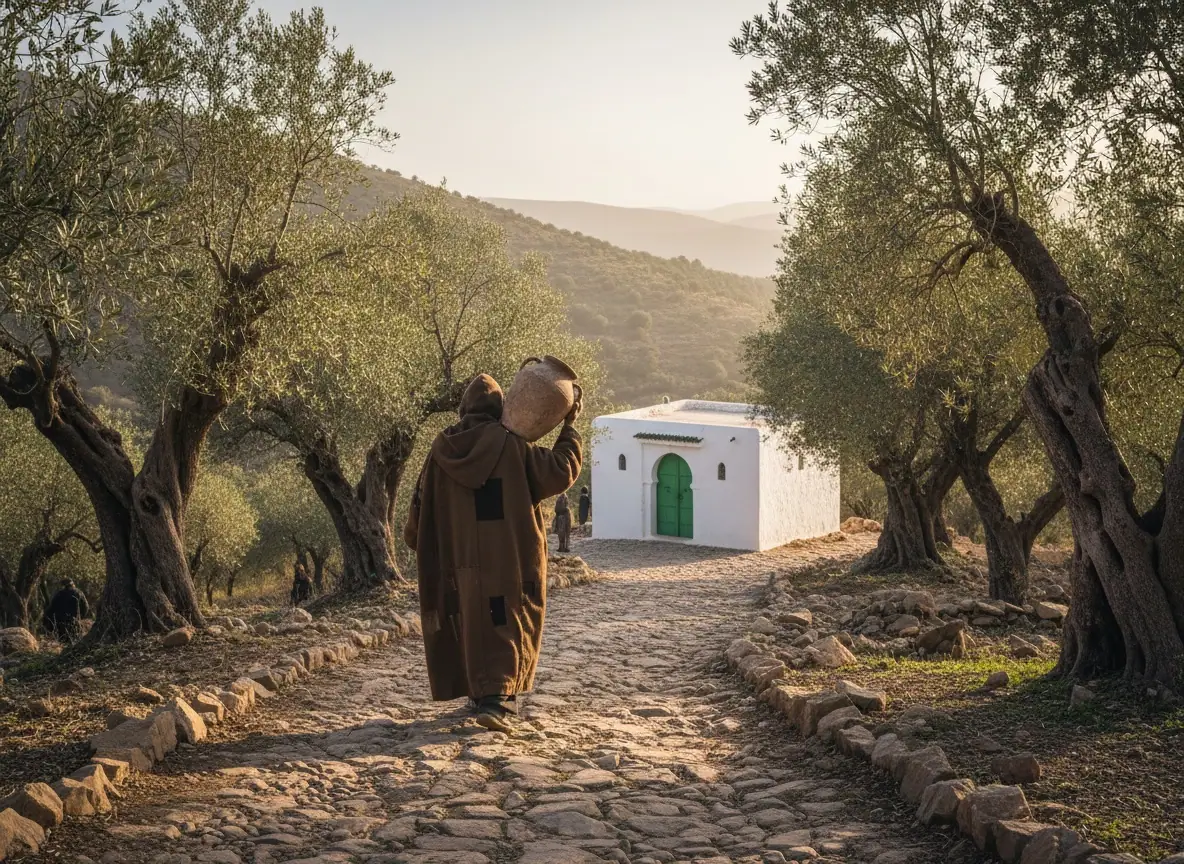
- Breaking the ego through humble acts, such as wearing a patched cloak, carrying water or loads, or asking in the market, done under a teacher’s guidance and never for display.
- Contentment with what God decrees, and seeing His work in every event, pleasant or hard.
- Keeping the law of Islam carefully: for al-Darqawi, the inner path never replaces the outer one.
The practices of a Darqawi circle
The daily wird of most Darqawi branches has three parts, each recited about a hundred times morning and evening: asking forgiveness, blessings on the Prophet ﷺ, and the testimony of oneness. Gatherings add the standing hadra, the Ṣalāt al-Mashīshiyya of Moulay Abdessalam Ibn Mashish, al-Shadhili’s litanies such as the Ḥizb al-Baḥr, and the sung poems of al-Harraq of Tetouan. We describe these in more detail in our article on Shadhili dhikr.
His heirs
Al-Darqawi’s disciples carried the teaching in several directions:
- Ahmad ibn ʿAjiba of Tetouan (d. 1809), jurist and Qur’an commentator, whose commentary on the Ḥikam of Ibn ʿAtaʾillah is still taught.
- Muhammad al-Harraq of Tetouan (d. 1845), whose poems of love and longing are sung in Shadhili gatherings across Morocco.
- Muhammad al-Buzidi (d. 1814), who took the teaching to Mostaganem in Algeria; from his line came Ahmad al-ʿAlawi (d. 1934), whose branch spread to Europe.
- In the twentieth century, Muhammad ibn al-Habib of Meknes (d. 1972), whose diwan of poems is recited in many circles today.
Fes and the Darqawi path on our retreats
Our three Fes retreats, Heritage, Signature and Luxury, spend a morning with the masters of the city, including the zawiya of Sidi ʿAli al-Jamal in Rmila, followed by a discussion on spiritual education and good character. Evening gatherings include litanies and ṣalawāt of the Shadhili path where the hosts agree. Bu Brih, al-Darqawi’s own zawiya, lies far into the hills north of Fes and is not part of the standard programme.
Guests on the devotional track take part in the litanies; guests on the open track are welcome to listen. Dates are shared by the three tiers and confirmed once 10 guests have joined; see the current ones on our group dates page.
Questions
What is the Darqawi tariqa?
A branch of the Shadhili path renewed in eighteenth-century Morocco by Moulay al-ʿArabi al-Darqawi, disciple of Sidi ʿAli al-Jamal of Fes, centred on remembrance, inner poverty and humility.
Who was Moulay al-ʿArabi al-Darqawi?
A Moroccan Sufi master (c. 1737–1823) from the Bani Zarwal, north of Fes, whose letters and disciples shaped much of the Shadhili practice in North Africa.
Who was Sidi ʿAli al-Jamal?
A Sufi master of Fes (d. 1779), teacher of al-Darqawi and author of Naṣīḥat al-murīd, translated as The Meaning of Man.
Where is al-Darqawi buried?
At his zawiya in Bu Brih, in the hills of the Bani Zarwal north of Fes.
What do the Darqawa recite?
A daily wird of asking forgiveness, blessings on the Prophet ﷺ and the testimony of oneness, plus the Ṣalāt al-Mashīshiyya, Shadhili litanies and the poems of al-Harraq in gatherings.
Are al-Darqawi’s letters available in English?
Yes. Titus Burckhardt’s Letters of a Sufi Master is a selection, and fuller translations have been published since.