Journal · 6 min read
Shadhili dhikr: the wird, the hadra and what to expect on retreat
By Nūr Morocco ·
In short
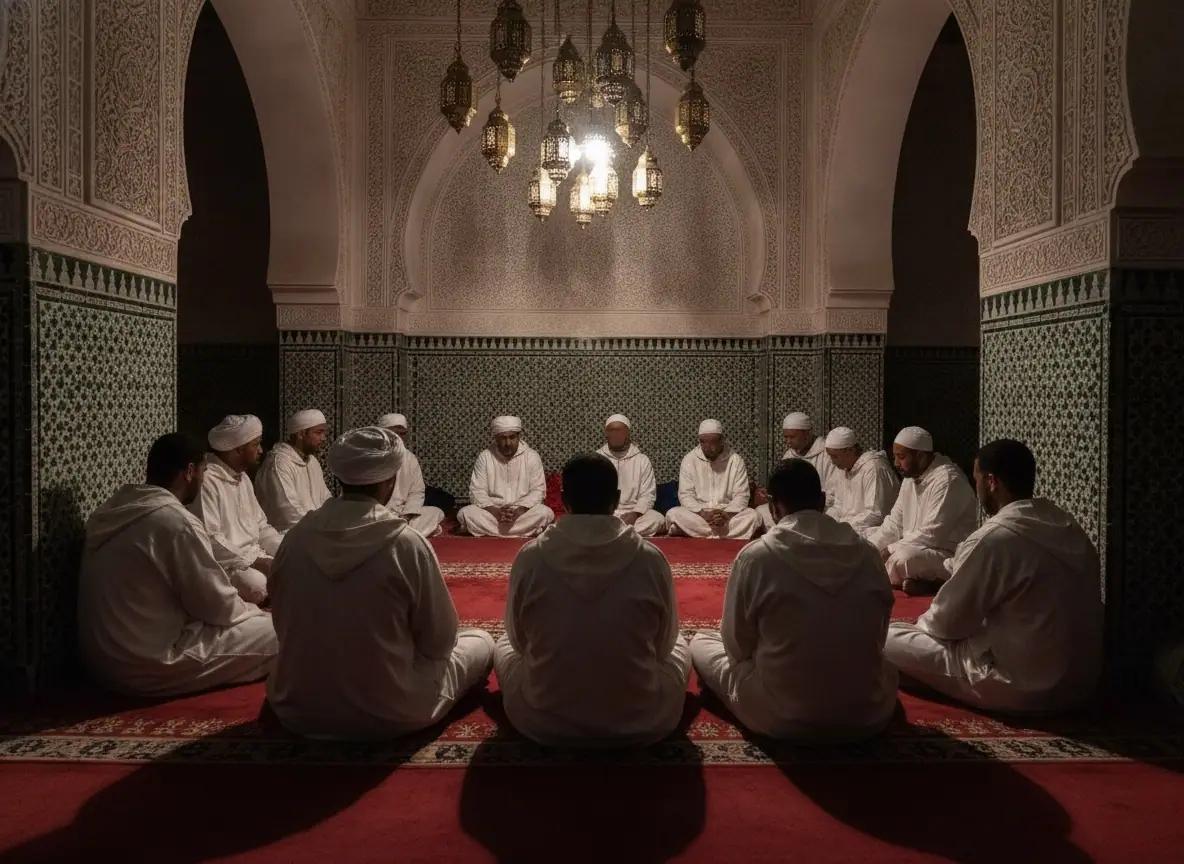
On the Shadhili path, dhikr is woven through an ordinary day rather than kept for a hermitage. A disciple usually recites a short daily litany, the wird, morning and evening: asking forgiveness, blessings on the Prophet ﷺ and lā ilāha illā Allāh, often a hundred times each. Longer litanies such as the Ḥizb al-Baḥr and prayers such as the Ṣalāt al-Mashīshiyya are added, and the circle meets for a collective dhikr, the ḥaḍra, usually once a week. Guests on retreat take part or listen, with simple courtesies.
Dhikr in the Qur’an
Dhikr means remembrance: the remembrance of God, in the heart and on the tongue. The Qur’an asks for it again and again. “Remember Me, and I will remember you,” says one verse, which goes on to ask for gratitude (2:152); another says that “in the remembrance of God hearts find rest” (13:28). Our beginner’s guide to dhikr explains the common phrases and what they mean.
The Shadhili teachers read these verses together. Remembrance and gratitude go side by side, and the aim is a heart that stays with God while the hands are busy. Imam Abu al-Hasan al-Shadhili did not ask his followers to leave their trades or their families; he asked them to keep God in mind in the middle of both. You can read more about him in our article on Abu al-Hasan al-Shadhili.
The daily wird
The heart of a disciple’s practice is the wird, a short litany given by the teacher of the path and recited every day, usually after the dawn prayer and again after the sunset prayer. Its exact form differs from one branch to another. In many Moroccan Shadhili circles, including those that descend from the Darqawi renewal, it has three parts, each recited about a hundred times:
- Astaghfiru Allāh: I ask God’s forgiveness. The wird begins by turning back to God.
- A prayer of blessing on the Prophet ﷺ, such as Allāhumma ṣalli ʿalā sayyidinā Muḥammad, al-nabī al-ummī, wa-ʿalā ālihi wa-ṣaḥbihi wa-sallim.
- Lā ilāha illā Allāh: there is no god but God, often completed at the end with Muḥammadun rasūl Allāh.
Why the wird is kept small
The wird takes perhaps a quarter of an hour. That is deliberate. The Shadhili teachers prefer a little, kept every day with attention, to a great deal done for a week and dropped. Ibn ʿAtaʾillah, in his treatise on dhikr, Miftāḥ al-falāḥ, describes how remembrance begins on the tongue with effort and, kept up, moves into the heart until it continues by itself.
A wird is received rather than invented: a disciple asks the teacher of the path, who gives it with his permission. A guest who is not a member of any order can still say the same phrases on their own, as any Muslim may; the formal wird of a path is a commitment that is taken on with a teacher.
Litanies and ṣalawāt
Alongside the wird, the Shadhili orders keep longer litanies, the aḥzāb, made of Qur’anic verses, prayers and invocations. The best known is al-Shadhili’s Ḥizb al-Baḥr, recited daily in many circles, often after the afternoon prayer. Some branches also recite a waẓīfa, a set sequence of prayers on the Prophet ﷺ, in the morning or evening.
Prayers of blessing on the Prophet ﷺ have a special place. The Ṣalāt al-Mashīshiyya of Moulay Abdessalam Ibn Mashish, the master of al-Shadhili, is recited in many Shadhili circles once a day; we explain it in our guide to Ibn Mashish. In Marrakech, the Dalāʾil al-Khayrāt of Imam al-Jazuli, a whole book of ṣalawāt, is read in sections through the week.
The ḥaḍra: dhikr together
Once a week, often on Thursday or Friday evening, the members of a circle meet in their zawiya or in a house for a collective dhikr. In Morocco it is often called the ḥaḍra, the “presence”. Its order varies from one circle to another, but most gatherings follow a similar shape.
- An opening: Qur’an, often al-Fātiḥa, and the litany of the order recited together.
- Repeated formulas, led by the muqaddam: lā ilāha illā Allāh, then the divine name Allāh, at first seated and slow.
- In many Shadhili-Darqawi circles, a standing dhikr in a circle, the participants swaying gently in rhythm while the names are repeated and a singer chants poems of the path, among them the poems of al-Harraq of Tetouan.
- Sung praise of the Prophet ﷺ (madīḥ) and of the path (samāʿ).
- A closing supplication (duʿāʾ), then often tea and a short talk.
Adab: dress, silence and sitting
Adab, courtesy, is half of a gathering. It is the same whether you are a member or a guest, and the hosts are always the ones who decide who attends and how.
- Come with wudu if you are Muslim, and dress modestly: loose clothes covering arms and legs; women cover their hair. Socks are useful, as shoes come off at the door.
- Sit where you are shown. In most circles men and women sit apart, or women gather in a separate room.
- Keep still and quiet. Do not talk during the dhikr, and switch your phone off.
- Do not record or photograph unless the host invites you to.
- If you do not know the words, listen. No one expects a guest to follow everything.
- Leave quietly if you need to, and thank the host at the end.
What the devotional and open tracks do
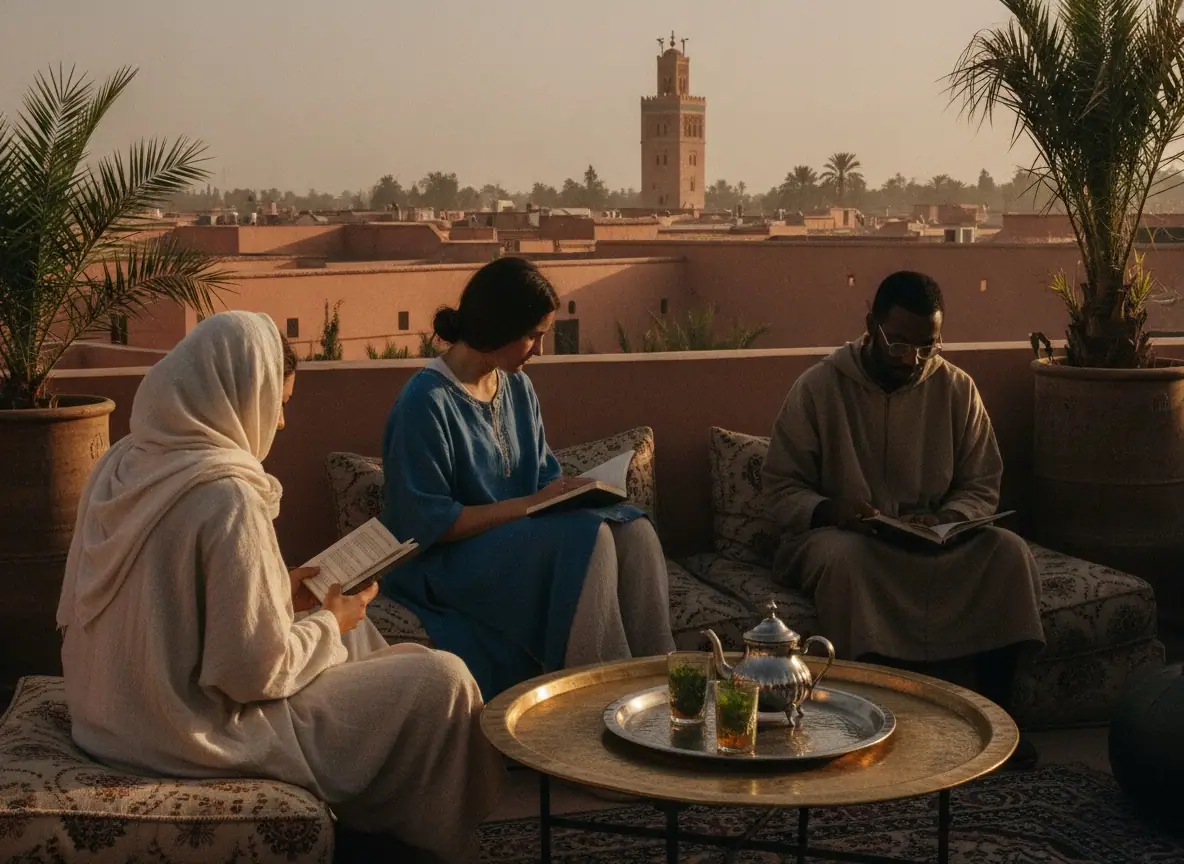
Every day of our retreats keeps time for dhikr and ṣalawāt, usually after the dawn prayer and in the evening. Guests on the devotional track recite with the facilitator: the morning and evening remembrances, ṣalawāt of the path and, on some evenings, a litany such as the Ḥizb al-Baḥr. Guests on the open track are welcome to sit in and listen, or to use the same time for reading and silence; nothing is asked of you beyond courtesy.
Gatherings with a zawiya are arranged for each date where the hosts agree, and we tell you before you book what has been confirmed. We do not promise a meeting with any particular teacher, and we do not give a wird: that belongs to the teachers of the path. Dates are shared by the three tiers of each city and confirmed once 10 guests have joined; see the current ones on our group dates page.
Questions
What is the Shadhili wird?
A short daily litany given by the teacher of the path and recited morning and evening. In many Moroccan Shadhili circles it is asking forgiveness, blessings on the Prophet ﷺ and lā ilāha illā Allāh, about a hundred times each; the exact form varies by branch.
Can I recite the wird without joining an order?
Anyone may say these phrases of remembrance. The formal wird of a path, though, is received from its teacher, with permission, as a commitment.
What is a hadra?
The weekly collective dhikr of a circle, often on Thursday or Friday evening: the litany of the order, repeated divine names, sometimes standing in rhythm, sung praise and a closing supplication.
Can non-Muslims attend a Shadhili dhikr?
Many circles welcome respectful guests, but not all and not always. On our retreats, guests on the open track attend as quiet guests where the hosts agree.
What should I wear to a dhikr?
Loose, modest clothes covering arms and legs, and clean socks, as shoes come off at the door. Women cover their hair.
Do I need to know Arabic?
No. Listening attentively is enough. On retreat the facilitator explains the meaning of the main phrases before a gathering.