Journal · 3 min read
Moulay Abdessalam Ibn Mashish: the saint of Jbel Alam
By Nūr Morocco ·
In short
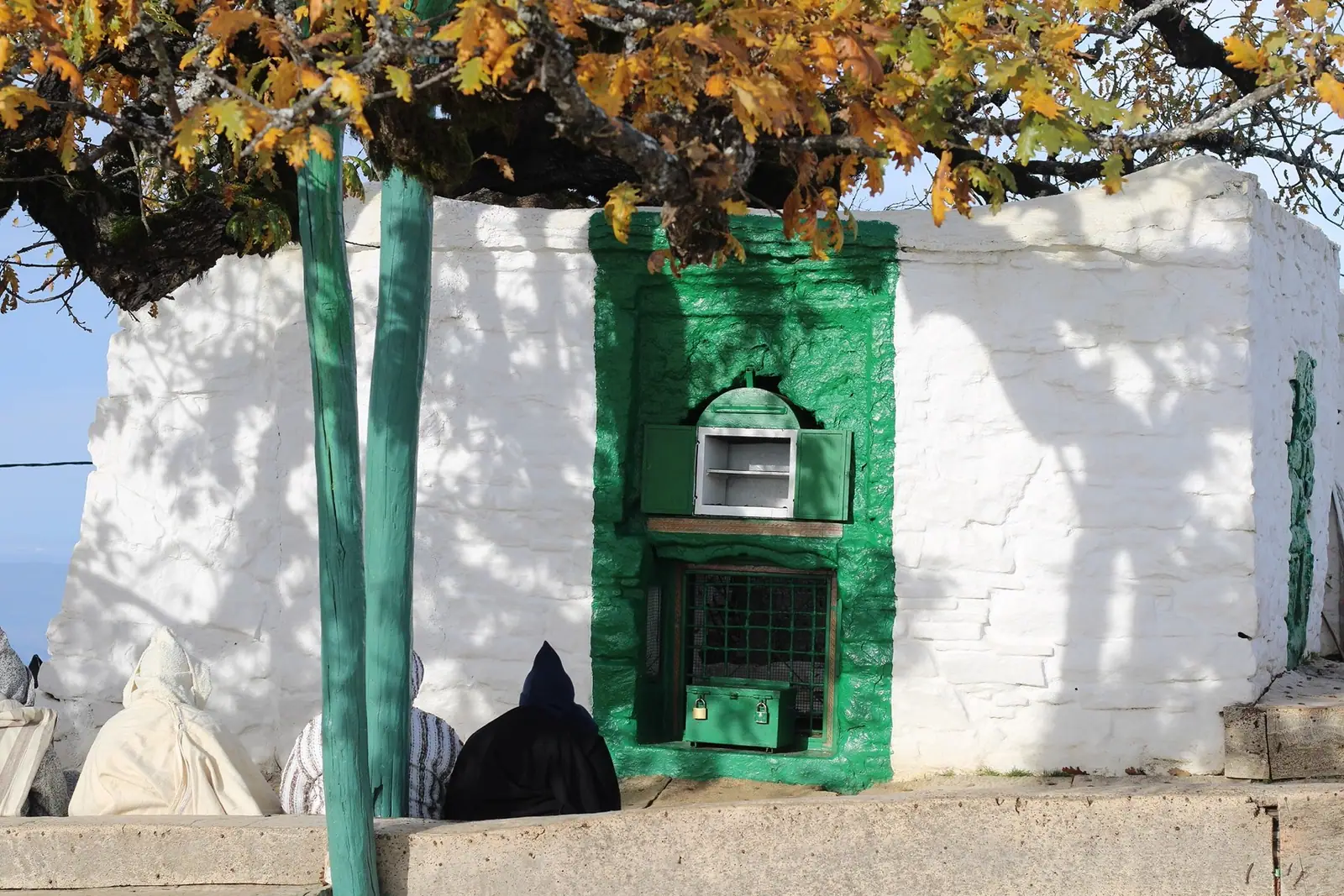
Moulay Abdessalam Ibn Mashish (d. c. 1227–28) was a descendant of Moulay Idriss who lived a life of worship on Jbel Alam, in the hills south of Tetouan. He was the master of Abu al-Hasan al-Shadhili, founder of the Shadhili path, and is known across the Muslim world for his prayer on the Prophet ﷺ, the Ṣalāt al-Mashīshiyya, often called the salawat of Ibn Mashish. His tomb stands on Jbel Alam, about 1 h 20 by road from Tetouan, and can be visited on our Jbel Alam day trip or our Shadhili Path retreat. His name is also written Abdeslam, Abd al-Salam and Mchich.
Who was Ibn Mashish?
Abd al-Salam ibn Mashish was a sharif, a descendant of the Prophet ﷺ through Moulay Idriss, founder of the first Islamic dynasty of Morocco, which is why Moroccans call him Moulay. He lived a life of worship on Jbel Alam, in the country of the Beni Arous, and died there around 1227–28.
He left almost no writing. His influence passed through one student. Abu al-Hasan al-Shadhili had searched for a master as far as Iraq, where he was told that the one he sought lived in his own country. He came to Jbel Alam, became the disciple of Ibn Mashish, and carried his teaching to Tunisia and Egypt, where the Shadhili path took shape.
The salawat of Ibn Mashish: the Ṣalāt al-Mashīshiyya
Ibn Mashish’s best-known legacy is a short, dense prayer of blessing on the Prophet ﷺ, the Ṣalāt al-Mashīshiyya. It is recited daily in many Sufi circles, especially in the Shadhili orders, and has been the subject of several commentaries, among them one by the Moroccan Shadhili master Ahmad ibn ʿAjiba (d. 1809).
On our Shadhili Path retreat this prayer is at the centre of the day on Jbel Alam: its meaning is explained to every guest, and guests on the devotional track recite it together on the mountain.
The tomb of Ibn Mashish on Jbel Alam
Jbel Alam rises in the Beni Arous hills of the western Rif. The tomb stands on the mountain, and the last part of the way is on foot. Every year a large moussem gathers pilgrims there; outside it, the mountain is quiet, which suits a retreat.
Visits depend on the custodians and on the state of the mountain road, so we confirm access for each date before you book.
How to get there
- From Tetouan: 62 km, about 1 h 20 on mountain roads.
- From Chefchaouen: 46 km, about 1 h 10.
- From Tangier: 82 km, about 1 h 45.
- The last stretch is a narrow mountain road: allow more time than the estimate, and bring modest clothing and comfortable shoes.
The adab of the visit
Come with wudu if you can, and dress modestly; women cover their hair. Greet the saint, recite al-Fatiha, pray to God and keep your voice low. Many visitors also recite the Ṣalāt al-Mashīshiyya. Guests on our open track are welcome to sit quietly or walk on the mountain while others pray.
Questions
Who was Moulay Abdessalam Ibn Mashish?
A sharif of the line of Moulay Idriss who lived on Jbel Alam in northern Morocco and died around 1227–28. He was the master of Abu al-Hasan al-Shadhili, founder of the Shadhili path.
Where is the tomb of Ibn Mashish?
On Jbel Alam, in the Beni Arous hills south of Tetouan: about 1 h 20 by road from Tetouan, 1 h 10 from Chefchaouen and 1 h 45 from Tangier.
What is the salawat of Ibn Mashish?
The Ṣalāt al-Mashīshiyya: a prayer of blessing on the Prophet ﷺ composed by Ibn Mashish, recited daily in many Sufi circles, especially in the Shadhili orders.
Can I take a tour to the tomb of Ibn Mashish?
Yes. Our Jbel Alam day trip goes up to the tomb from Tetouan, Chefchaouen or Tangier with a guide, and our Shadhili Path retreat gives it a full day. Access depends on the mountain road and the custodians, so we confirm it for each date.
How do I visit Jbel Alam?
Our Jbel Alam day trip goes up from Tetouan, Chefchaouen or Tangier, and our five-day Shadhili Path retreat gives a full day to the mountain, with Tetouan and Sidi Ahmad ibn ʿAjiba. Access is confirmed for each date.