Journal · 9 min read
Halal Holidays in Morocco: A Spiritual Heritage Guide for Muslim Travellers
By Nūr Morocco ·
In short
A halal holiday in Morocco is unusually easy to arrange, because the country already lives on Muslim time: almost all meat is halal, the call to prayer reaches every neighbourhood, and modest dress is unremarkable. What actually needs planning is your accommodation — alcohol policy, pool privacy, family rooms — and the shape of your days.
That last part is where most guides stop, and where this one begins. A halal holiday in Morocco can also be a spiritual one: five days built around ziyara, dhikr and sacred study in Marrakech or Fes, with prayer as the rhythm of the trip rather than an interruption to it.
What "halal holiday" means in Morocco
A halal holiday is a trip planned around the needs of Muslim travellers: halal food at every meal, time and space to pray, modest and family-friendly accommodation, and privacy where it matters. In Morocco the food and prayer parts are effectively free — the accommodation part is not, and that is where you should spend your attention.
Why Morocco is easy — and what is genuinely different
Morocco is a Muslim-majority country whose religious life rests on the Maliki school of law, the Ashʿari creed and the Sufism of al-Junayd. Islam is the religion of the state and the King holds the title of Commander of the Faithful; the Ministry of Habous and Islamic Affairs oversees mosques, many zawiyas and shrines, and publishes the official prayer times.
In daily terms, that means:
- Meat is halal by default, in markets, butchers, family restaurants and hotels alike. Pork is not part of the national cuisine.
- You will hear the adhan in every city and village, and there is a mosque within walking distance almost anywhere. Muslims may join the prayer; the great exception to the usual rule on non-Muslim entry is the Hassan II Mosque in Casablanca, which runs guided visits outside prayer times.
- Modest dress is respected and required at mosques and shrines; there is no legal dress code for visitors.
- Family travel is normal, and no mahram is required by Moroccan law for women travelling.
One correction to a common assumption: Morocco has a real halal certification system — the "Halal Maroc" label, managed by the national standards institute IMANOR under standard NM 08.0.800 — but certification attaches to specific products, services and sites listed in its register, not to whole hotels by virtue of being in Morocco. A riad that serves halal food is almost certainly serving halal food because the country's supply is halal, not because it holds a certificate. Treat "certified halal hotel" claims from any operator with care, including ours.
Where the friction actually is
Food and prayer rarely cause difficulty. Three other things do.
Alcohol. It is legal, licensed and tightly regulated in Morocco. Many family restaurants, cafés and riads simply do not serve it; larger hotels and resorts often do, in shared bars and terraces. If you want none around you, ask directly whether the property serves alcohol anywhere on site — not only at your table.
Pool, hammam and spa arrangements. Public pools and beaches are mixed. Some hotels set aside women-only hours; private villas and whole-riad bookings offer fully secluded pools. Hammams and spa treatment rooms can usually be booked privately, sometimes by prior request. Ask what is mixed, what is private, and on which days.
Shared space and room configuration. A traditional riad turns inward around a courtyard, which is discreet by design — but a shared courtyard is shared. Whole-riad bookings solve this: no outside guests, your family or circle alone in the house.
Choosing a stay that fits
| Type of stay | What it offers Muslim travellers | What to confirm |
|---|---|---|
| Traditional riad | Small scale, inward-facing courtyard, family atmosphere, often no alcohol | Alcohol policy; stairs for small children or elderly parents; connecting rooms |
| Whole-riad booking | Complete privacy for one family or group, private pool and dining | Minimum stay; availability on your dates; whether staff stay on site |
| Hotel or resort | Lifts, pools, larger rooms, on-site restaurants | Whether alcohol is served in shared areas; pool and spa arrangements for women |
| Desert camp (Erg Chebbi) | Private tents, dinner and breakfast, quiet in the dunes | En-suite bathroom, meal timing, spacing between tents |
| Valley guesthouse (Dadès, Todra) | Quiet, family-run, home cooking | Heating in winter, room layout for your family |
Four routes that suit a halal holiday
Marrakech. The city's spiritual geography is the Seven Saints — the traditional ziyara route through the medina, associated with Imam al-Jazuli, author of the Dalāʾil al-Khayrāt, and Sidi Bel ʿAbbès. A guided ziyara here is a half-day, walked at a calm pace, and it changes what the city looks like afterwards.
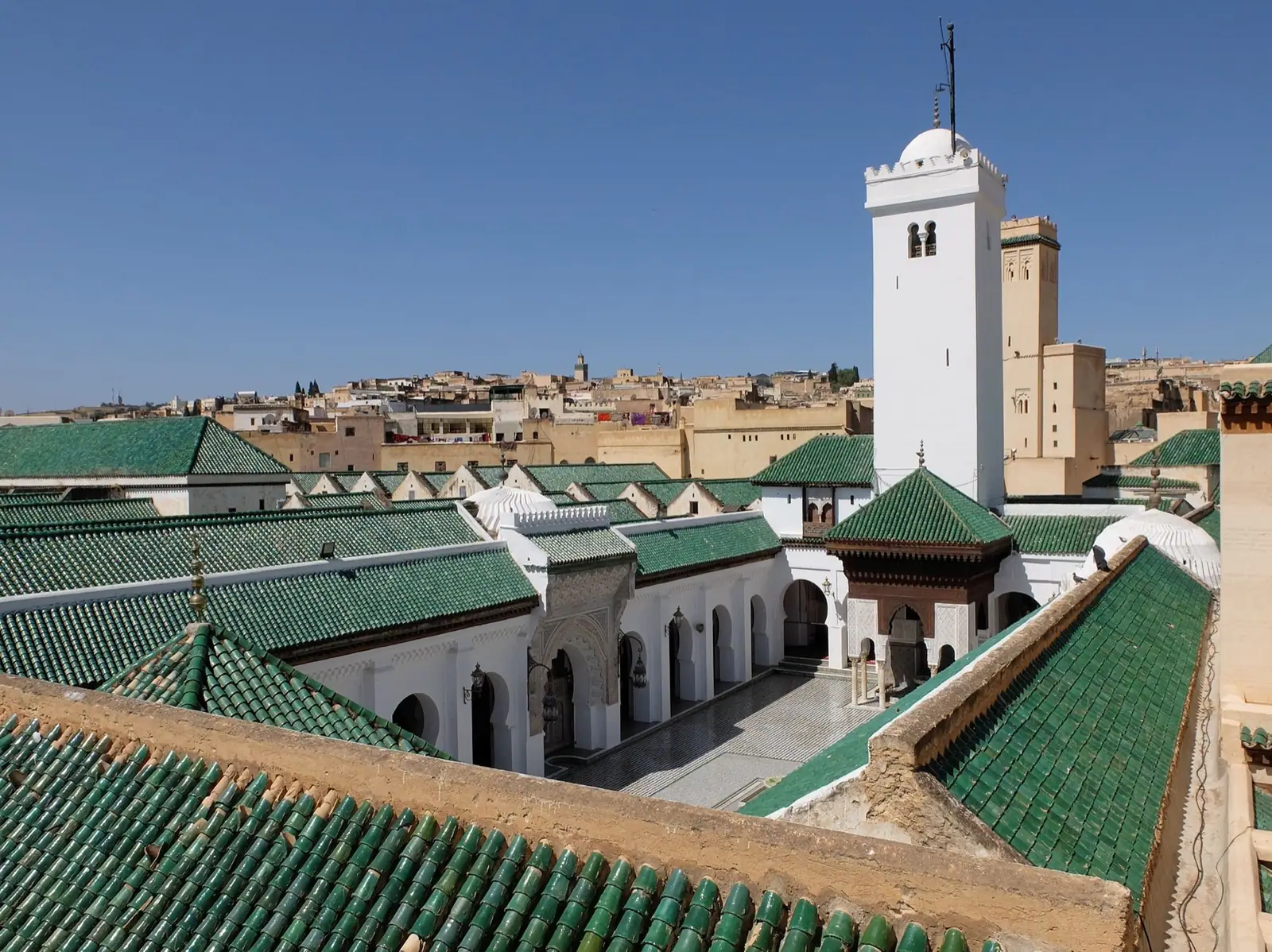
Fes. Fes el-Bali is a UNESCO World Heritage medina, and its sacred layer is dense: the sanctuary of Moulay Idrīs II, the al-Qarawiyyin mosque and its teaching tradition, the zawiya of Sidi Aḥmad al-Tijānī, and the sanctuaries of the masters of the Shadhili chain. Al-Qarawiyyin was founded as a mosque by Fatima al-Fihri in 857–859 and is cited by UNESCO and Guinness World Records as the oldest continuously operating institution of higher learning in the world.
The north. Chefchaouen and the Rif, Tangier and the Atlantic edge — quieter, cooler, well suited to families who want a gentler pace and shorter distances. Moulay Idriss Zerhoun, the mountain town above Meknes, is a natural extension for a group already in Fes.
The south. The Dadès and Todra valleys, the Drâa and the Sahara. Fewer people, longer horizons, and the easiest place in the country to keep a completely quiet daily rhythm.
Keeping the spiritual thread
A halal holiday and a spiritual holiday are not the same thing, but in Morocco they overlap easily. Ziyara — the visit to the tombs of the saints and to zawiyas — has its own adab: visit outside prayer times, greet the people of the graves, recite al-Fatiha, direct your prayers to God alone, and follow the custodian's guidance. Some interiors are reserved for Muslim visitors; many are entered with a local guide who knows the household.
Our five-day retreats in Marrakech and Fes are built exactly on that rhythm: ziyara with a licensed local guide, daily dhikr and ṣalawāt, time for Qur'an and quiet, and evenings of Moroccan madīḥ where arranged. Each runs on one of two tracks that follow the same route — a devotional track for Muslims walking the path, with congregational prayer, full participation in the zawiya, and the Mashīshiyya, Dalāʾil al-Khayrāt and Ḥizb al-Baḥr recited together; and an open track for any seeker, where prayer times are kept as moments of quiet and shrines are visited from outside where the interior is reserved.
Timing: seasons, Ramadan and the Eids
Spring and autumn are the comfortable months for walking medinas and shrines; summer heat makes a slower, shorter-day programme sensible.
Ramadan transforms the country, and many Muslim travellers choose it deliberately. Days are quiet, some cafés and restaurants close or serve visitors only, offices keep shorter hours — and then the whole country breaks the fast together at sunset, usually with harira, dates and chebakia, and the nights fill with the tarāwīḥ prayer. Morocco moves its clocks back to GMT for the month. For retreat dates, what a five-day stay includes and how group departures work, read our guide to Sufi retreats in Morocco.
The Mawlid and the two Eids are the country's other great seasons — family time above all, so book well ahead and expect some businesses to close.
Travelling as a family or a group of ten
The most common friction point for a family or a study circle is not halal food; it is the accommodation unit. A conventional hotel scatters a group across floors and shared space. A riad buyout does the opposite: one historic house, reserved entirely for your party, with private suites, a courtyard, a rooftop terrace and a chef preparing all meals halal and to your dietary requirements.
Ten is close to the ideal size for this kind of travel. It fills a riad without crowding it, moves through narrow medina alleys without becoming a procession, enters a zawiya respectfully, and keeps a single vehicle sufficient for everyone — including elderly parents and young children.
If you are joining a scheduled departure rather than a private one, the mechanics are simple: you reserve a place, the date is confirmed once ten guests have joined, and only then do you pay a 30% deposit and book flights. If a date is not confirmed 45 days before departure, you are moved to the next one or refunded. See group dates for what is currently open.
Our five-day retreats in Marrakech and Fes run at three levels — Heritage, Signature and Luxury — across the same route and programme, and groups of ten or more can take a private Wednesday-to-Sunday date of their own.
If you are coming from Umrah
Pilgrims who have just completed the rites often want the journey to continue rather than end at the airport. Morocco works well as that extension: Fez and Marrakech offer a contemplative counterpoint to the intensity of Makkah and Madinah, with the same riad-based, small-group format. We set out the routes and private-circle logistics on our private-group retreats page.
Questions
Is Morocco good for a halal holiday?
Yes. Morocco is a Muslim-majority country where halal meat is the everyday standard, prayer facilities are everywhere and modest dress is normal. What needs planning is accommodation: alcohol policy, pool privacy and room layout for families. Choose the property carefully and the rest of the trip is straightforward.
Is all food in Morocco halal?
Almost all meat sold in Morocco is halal, in markets, butchers, restaurants and hotels, and pork is not part of the national cuisine. A small number of tourist-oriented restaurants and hotels in resort areas serve pork or alcohol. Ask before you order if either matters to you; family restaurants and most cafés serve neither.
Are hotels in Morocco alcohol-free?
Some are, many are not. Family-run riads frequently serve no alcohol at all, while larger hotels and resorts usually do in shared bars and restaurants. Morocco has no scheme that certifies whole hotels as halal, so confirm the property's own policy directly rather than relying on a label.
Can non-Muslim family members or friends join a halal holiday?
Yes. Nothing about a halal holiday restricts who travels with you; it describes how the trip is arranged — halal meals, prayer times respected, modest and private accommodation. On our retreats, the open track exists precisely for companions of any faith or none who want to travel with the group.
Is a riad better than a hotel for a halal holiday?
For privacy, usually yes. A riad turns inward around a courtyard, is small and family-run, and many serve no alcohol; a whole-riad booking gives your family or group the house entirely. Hotels offer lifts, pools and larger rooms, but more shared space and a higher chance of alcohol service on site.
Is Ramadan a good time for a halal holiday in Morocco?
Many Muslim travellers find it the best time. The atmosphere after sunset is extraordinary, the tarāwīḥ prayer is held in every neighbourhood, and the country is at its most spiritually alive. Days are quieter with shorter business hours, so plan lighter sightseeing and confirm meal arrangements in advance. Ramadan 2027 is expected to begin around 8 February 2027, subject to the sighting of the moon.
Sources
- Ministry of Habous and Islamic Affairs — prayer times, mosques, zawiyas and shrines
- Hassan II Mosque Foundation — visitor access and guided tours
- IMANOR — the "Halal Maroc" label and standard NM 08.0.800
- USDA GAIN: Morocco Halal Label — certification for the right of use
- International Trade Centre: halal certification in Morocco
- UNESCO: Medina of Fez — al-Qarawiyyin and the medina
- GOV.UK: foreign travel advice, Morocco
Plan a halal holiday built around prayer, ziyara and quiet.
Plan your retreat →